For years, businesses across industries relied on a simple workaround to deliver text messages without using a traditional SMS platform: email-to-SMS gateways. By sending an email to a carrier-assigned address like [phonenumber]@vtext.com, companies could push appointment reminders, alerts, booking confirmations, and system notifications directly to mobile devices as text messages. It was fast, inexpensive, and didn’t require any additional infrastructure beyond an email client.
But that era is officially coming to an end — and if your organization still depends on this method instead of dedicated SMS marketing software, you could soon find your messages silently failing to reach customers.
Major U.S. Carriers Are Phasing Out Email-to-Text Gateways
Telecom providers in the United States have steadily moved away from supporting email-to-SMS functionality over the past few years. Sprint discontinued its gateway services in early 2022, and Boost Mobile’s infrastructure has since gone offline. T-Mobile’s gateway became increasingly unreliable throughout 2024 and appears to have stopped functioning altogether by the end of the year.
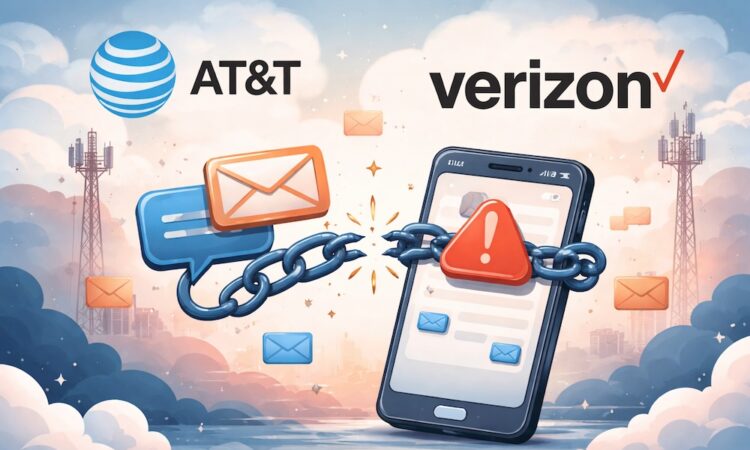
Verizon’s once-widely used vtext.com service has experienced persistent delivery failures, and the company is no longer onboarding new users. In fact, Verizon now discourages businesses from relying on the service for operational messaging.
AT&T has taken things even further by formally announcing the shutdown of both its email-to-text and text-to-email services, scheduled for June 17, 2025.
For organizations that use automated systems — such as monitoring platforms, booking engines, healthcare reminders, logistics alerts, or customer support notifications — this change can have immediate consequences. Many of these tools were configured to route messages through carrier gateways, meaning they depend entirely on infrastructure that is no longer guaranteed to function.
If your company still sends automated communications through a carrier email-to-SMS address, there’s a strong possibility those messages will soon stop being delivered — if they haven’t already.
Why Businesses Used Email-to-SMS in the First Place
Email-to-SMS became popular because it allowed IT teams and operations managers to integrate messaging into their workflows without deploying additional software. Systems could automatically send an email when a server went down, when a customer booked an appointment, or when a delivery was delayed — and that email would be converted into a text message by the carrier.
This method proved useful in industries where real-time notifications were critical, including:
- Healthcare appointment reminders
- System monitoring alerts
- Customer service notifications
- Two-factor authentication messages
- Emergency broadcast alerts
- Booking and scheduling confirmations
Because it bypassed traditional SMS platforms, it was seen as a low-cost alternative to purpose-built messaging solutions.
However, that same simplicity is also why it’s now being retired.
The Risks of Relying on Carrier Gateways
Carrier-provided email-to-SMS services were never intended for high-volume or mission-critical business messaging. As companies scaled their communications, telecom providers began to encounter increasing abuse, spam, and security vulnerabilities tied to open gateway infrastructure.
Without authentication protocols, encryption layers, or opt-in compliance controls, these gateways became a liability for carriers — especially as messaging regulations tightened across industries such as healthcare, finance, and government services.
As a result, telecom companies are prioritizing secure, regulated messaging frameworks and phasing out legacy tools that lack the safeguards required for modern communication environments.
For businesses, this means that continuing to rely on email-to-SMS could expose operations to:
- Delivery failures
- Message filtering or blocking
- Compliance violations
- Data privacy concerns
- Service outages with no notice
What Comes Next?
Organizations now face a critical transition point: replace outdated carrier-based messaging with a reliable alternative that can support both operational alerts and customer engagement.
While hardware gateways offer one potential solution by converting emails into SMS locally through SIM-based devices, many businesses are opting for scalable platforms that can integrate messaging directly into CRM systems, marketing automation tools, and booking workflows.
This shift allows companies to:
- Automate communications securely
- Maintain delivery reliability
- Ensure opt-in compliance
- Track performance metrics
- Protect customer data
More importantly, it enables organizations to continue using familiar workflows — without depending on telecom gateways that are being permanently retired.
How Trum·pia Helps You Maintain Email-to-SMS Functionality
Even as carriers discontinue their native services, Trum·pia continues to support email-to-SMS messaging through its platform. Instead of routing messages through telecom domains that may fail or disappear, Trum·pia’s system converts email inputs into compliant SMS messages using secure messaging infrastructure.
This means your organization can:
- Continue sending automated alerts
- Trigger SMS reminders from booking systems
- Deliver appointment confirmations
- Notify staff of system events
- Send promotional or service updates
All without relying on unsupported carrier gateways.
Because Trum·pia integrates directly with your existing tools and workflows, transitioning away from email-to-SMS services doesn’t require rebuilding your entire messaging process from scratch.
Future-Proof Your Business Messaging
With AT&T’s shutdown date approaching and Verizon’s gateway reliability already declining, organizations that delay migrating away from carrier-based email-to-SMS risk losing a critical communication channel altogether.
Replacing legacy messaging workflows with a platform designed for secure, scalable SMS delivery helps ensure your alerts, reminders, and notifications continue to reach the people who rely on them.
If your systems still depend on carrier gateways to send text messages, now is the time to explore a modern alternative.
To learn how Trum·pia can support your messaging needs and help you maintain email-to-SMS capabilities without disruption, call or text 1-888-707-3030 today.